
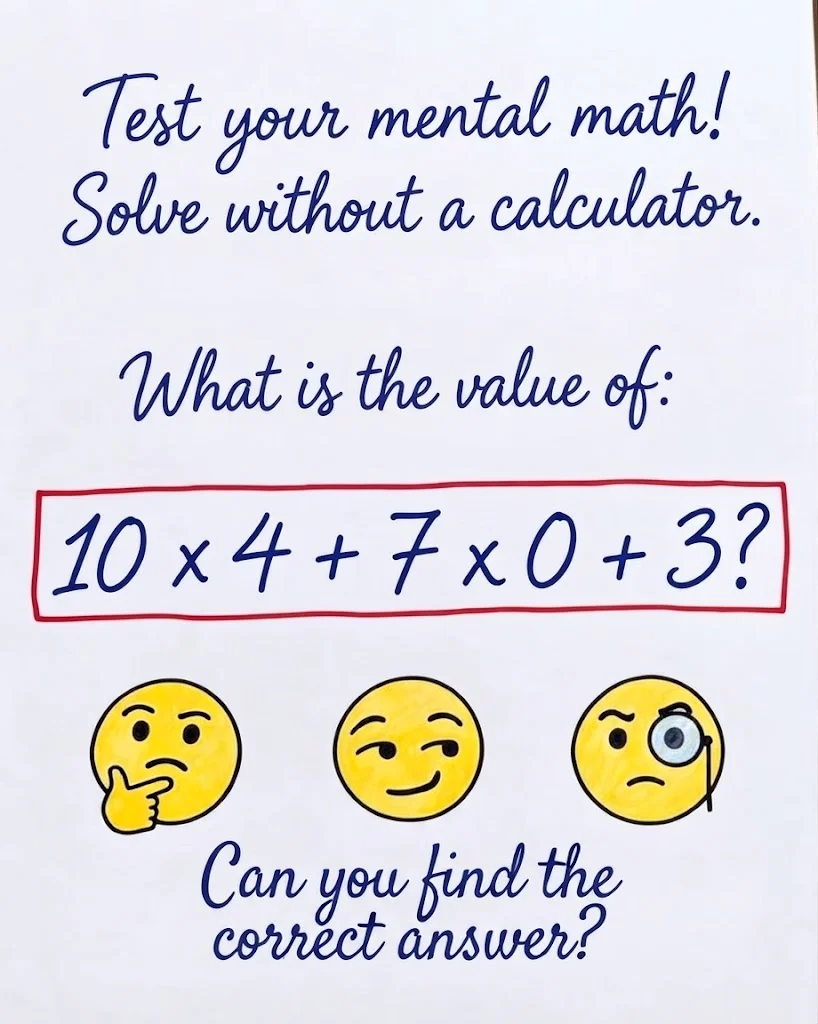
Some math problems look so easy that people answer them without a second thought. But a small detail can quickly turn a simple calculation into a surprisingly confusing challenge.
Take a look at this equation:
10 × 4 + 7 × 0 + 3 = ?
What answer did you get?
At first, the zero in the middle may catch your attention. Some people see multiplication by zero and assume the entire expression must equal zero. Others make mistakes by adding the numbers before completing the multiplication.
The key to solving this puzzle correctly is remembering the order of operations.
This mathematical rule, commonly known as PEMDAS or BODMAS, tells us which calculations must be completed first. Multiplication and division come before addition and subtraction, so the equation cannot simply be solved from left to right.
Let’s work through it step by step.
Start with the first multiplication:
10 × 4 = 40
Next, calculate the second multiplication:
7 × 0 = 0
Remember, multiplying any number by zero always gives zero.
With both multiplication operations completed, the equation becomes:
40 + 0 + 3
Now there are only additions left. Adding zero doesn’t change the value, so 40 remains 40.
Finally:
40 + 3 = 43
The zero may look like the most important part of the puzzle, but it only affects the multiplication beside it. It does not turn the entire equation into zero.
This little brain teaser is a useful reminder that even basic mathematics requires us to pay attention to the rules rather than rush toward an answer.
So, did you get 43 on your first try, or did the zero confuse you?
Share your answer and challenge your friends to solve the equation without looking at the explanation!