Robert De Niro Launches Fierce Attack on Trump at Voting Rights Rally, Calls on Americans to Defend Their Ballots
“HANDS OFF OUR VOTE!” Robert De Niro Erupts Against Trump at New York Rally — Hollywood Star Turns Voting Rights Into a Major 2026 Midterm Battle
The legendary actor delivered an aggressive political message at a New York voting rights gathering, taking direct aim at Donald Trump, criticizing Republican lawmakers and warning Americans not to surrender their influence at the ballot box. With the November 3 midterm elections drawing closer, his profanity-filled speech has brought renewed attention to the heated national debate over election procedures, federal authority and the growing influence of celebrities in American politics.
Robert De Niro has spent years making his opposition to Donald Trump unmistakably clear. However, his latest appearance at a New York voting rights rally brought that familiar political hostility into an especially intense setting. Standing before activists and supporters, the Oscar-winning actor delivered a blunt warning about the future of American elections and called on citizens to remain alert to any government actions that could affect their ability to vote.
The gathering, known as “Hands Off Our Vote,” attracted activists, concerned citizens and recognizable public figures, including fellow Hollywood actor Mark Ruffalo. Although the participants came with different backgrounds and perspectives, the event centered on one common message: Americans must retain the ability to choose their representatives, election procedures must remain open to scrutiny, and voting rights should not become a political bargaining tool.
De Niro quickly became the center of attention. His remarks were anything but restrained. He repeatedly demanded that political leaders keep their hands away from Americans’ voting rights, directing particularly harsh criticism toward Trump and using profanity to emphasize his frustration.
The speech transformed what could have been a conventional discussion about election administration into a much broader confrontation over political authority and democratic participation.
Yet beneath the confrontational language was a more substantial argument. De Niro wanted supporters to understand that the upcoming midterms represented an opportunity to influence the direction of the federal government. He encouraged Americans to stay involved, challenge policies they believe could interfere with voting access and work toward changing the political balance in Washington.
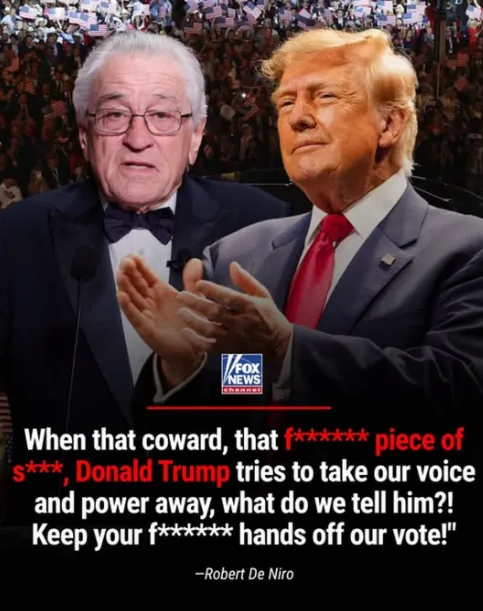
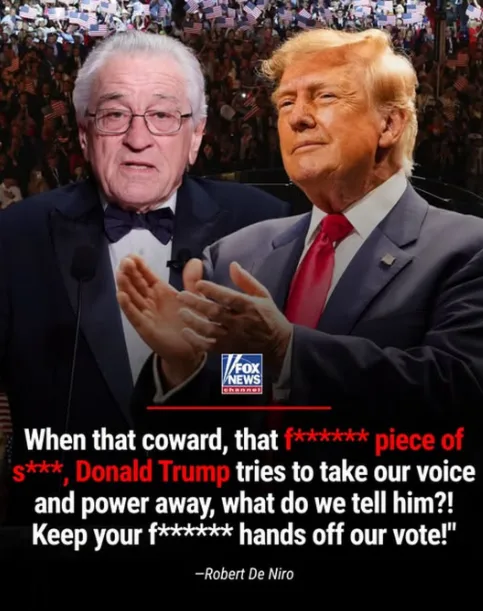
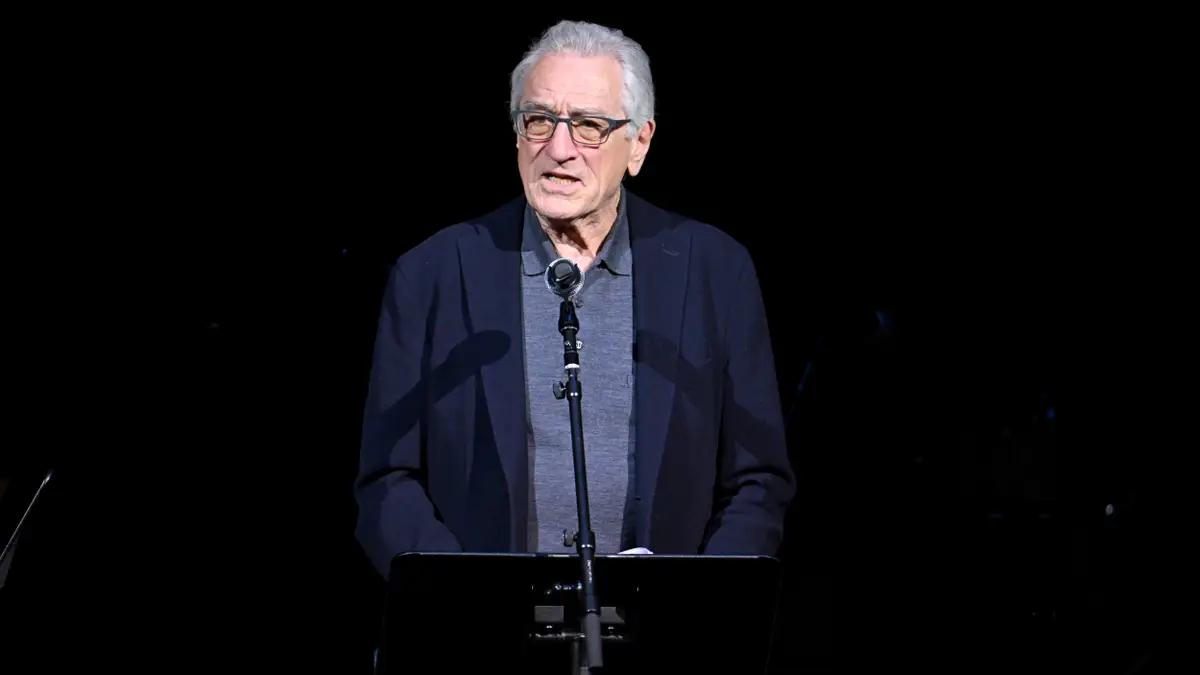
The photograph now circulating online captures a particularly forceful moment from the gathering, but it does not tell the entire story. The quoted remarks are presented as authentic in the supplied account, although the image itself cannot verify every accusation made during the speech.
That distinction becomes increasingly important as political messages spread across social media ahead of November 3, 2026. Discussions about election security, voter registration and federal authority are already highly contentious, and dramatic statements can easily become separated from the evidence needed to evaluate them.
The message behind De Niro’s explosive “Hands Off Our Vote” declaration
The central theme of De Niro’s speech was straightforward: American politicians should not interfere with the public’s ability to decide who governs the country.
His repeated demand, “Keep your hands off our vote,” became the defining expression of the rally. It reflected the concerns of participants who believe certain proposed changes to election procedures could create unnecessary difficulties for citizens who are legally entitled to participate.
Trump was the primary target of De Niro’s criticism, but the actor’s remarks extended beyond the president. He also challenged Republicans in Congress, the Supreme Court and the Justice Department under the Trump administration.
By bringing these institutions into the discussion, De Niro presented voting rights as a question involving the entire political system rather than a disagreement with one individual politician.
His language was deliberately aggressive. Instead of discussing registration databases, election procedures and administrative regulations in technical terms, he described the situation as a struggle over the political influence ordinary Americans should retain.
That approach is familiar in American political campaigning. Speakers at rallies frequently use memorable slogans, emotional appeals and sharp accusations to communicate urgency. The goal is not necessarily to explain every legal detail but to persuade supporters that an issue deserves immediate attention.
However, powerful rhetoric should not replace careful examination of the facts.
A political warning that a particular policy could threaten voting rights does not automatically establish that a court has found the policy unlawful. Likewise, a proposal to modify election procedures does not, by itself, demonstrate that eligible citizens have already been prevented from voting.
De Niro’s speech should therefore be understood as an expression of political opposition and advocacy, not as a legal determination concerning the president or other government officials.
The concerns he raised can still deserve serious consideration. The important point is that each accusation must be evaluated against the actual policy, available evidence and relevant legal decisions.
Immigration enforcement becomes another flashpoint in the controversy
Among the more striking portions of De Niro’s address was his warning about the possibility of immigration enforcement officers appearing near polling locations.
He described the scenario in sharply critical terms, connecting potential enforcement activity around voting sites with broader concerns about intimidation and the freedom of citizens to participate in elections.
The issue carries considerable political weight. A polling place should be an environment where eligible voters can cast their ballots without unlawful threats, pressure or interference. Even the possibility that someone could face unwanted scrutiny or intimidation while attempting to vote can generate serious concern.
However, discussing a potential threat is different from demonstrating that it has actually occurred.
The material provided does not establish that immigration enforcement officers were stationed near polling places as part of a coordinated nationwide effort to influence voting. De Niro’s remarks alone cannot confirm that such deployments took place or that any particular individual was prevented from participating in an election.
Establishing those claims would require additional information, including official enforcement instructions, deployment plans, specific locations, applicable legal restrictions and documented incidents involving voters.
There is also an important legal distinction between immigration enforcement carried out within the law and conduct that unlawfully interferes with voting. Whether a particular action violates someone’s rights depends on the circumstances and the relevant legal standards, not simply on which government agency is involved.
De Niro was expressing concern about what he believes could happen if government authority is used improperly. Whether that concern reflects an actual policy or a documented threat must be established through independent evidence.
Nevertheless, the underlying principle is significant. Eligible Americans should understand the rules governing their participation and should be able to exercise their voting rights without unlawful obstruction or intimidation.
November 3 could become a defining political moment for Trump’s presidency
The timing of the “Hands Off Our Vote” gathering was no coincidence. With the November 3, 2026, midterm elections approaching, the political stakes extend far beyond one celebrity’s appearance or one controversial speech.
The elections will determine the makeup of Congress and help establish the political environment for the remainder of Trump’s presidency. The outcome will influence legislative priorities, federal spending, congressional investigations, oversight responsibilities and the administration’s ability to move forward with its agenda.
De Niro’s message was therefore not limited to encouraging people to participate in democracy. He specifically called on supporters to use their votes to change the balance of power in Washington, including the possibility of shifting control of both the House of Representatives and the Senate.
That appeal revealed the broader political objective behind the gathering.
The rally was organized around voting rights, but it also functioned as an effort to mobilize opposition to Trump and encourage an electoral outcome favorable to those who want a different direction for the federal government.
There is nothing unusual about political organizations combining arguments about democratic participation with support for particular electoral objectives. However, the distinction should remain clear.
An appeal to protect voting rights does not necessarily represent a neutral position shared by every American. A speaker can defend democratic principles while simultaneously advocating for one political party or ideological direction.
De Niro was expressing his own political views as a celebrity activist. His remarks should not automatically be treated as an official statement representing every Democratic politician or voter.
Likewise, the intensity of the gathering offers no reliable indication of what the final election results will be. Celebrity appearances, enthusiastic crowds and viral social-media posts cannot determine the outcome of congressional races.
Ultimately, the results will depend on the ballots cast and counted according to the election rules governing each jurisdiction.
The growing national argument over voter registration and election security
The rally also comes at a time when Americans remain divided over how voter registration systems should operate, what measures are necessary to protect election integrity and how much authority federal officials should exercise over elections administered by individual states.
These questions are fundamental to the American electoral system.
Election officials must maintain accurate voter registration records, prevent administrative mistakes and ensure that elections are conducted according to established laws. At the same time, those procedures must protect eligible citizens from being incorrectly removed from registration lists or unnecessarily prevented from voting.
Supporters of stricter election procedures argue that reliable voter rolls and consistent verification requirements are essential for maintaining public confidence. They believe stronger administrative standards can help reduce errors and improve the overall integrity of elections.
Opponents of certain proposals see a different danger. They warn that complicated verification procedures, outdated databases and discrepancies between official records could create additional obstacles for otherwise eligible citizens.
For example, a voter whose personal information does not precisely match a government database might encounter difficulties that have little to do with whether that individual is legally entitled to vote.
This is why the practical consequences of election policies matter just as much as their stated intentions.
A policy described as an election-security measure should be examined to determine what problem it addresses, whether reliable evidence supports the need for it and what protections exist for eligible voters who encounter administrative errors.
On the other hand, allegations of voter suppression also require evidence. Investigators and courts must examine the actual wording of a policy, how it is implemented, whether it disproportionately affects particular groups and whether it violates applicable legal protections.
De Niro’s position was that political leaders should not manipulate election administration in ways that weaken the public’s influence over government.
That is a political argument about the risks he believes exist. It is not independent proof that every policy he criticized has illegally restricted voting access.
The larger debate raises several important questions that Americans should be able to examine without relying exclusively on partisan slogans.
Who qualifies to register? What procedures determine whether someone remains on the voter rolls? How can individuals challenge incorrect information? What responsibilities belong to state election officials, and where does federal authority begin? What legal protections exist when someone believes their voting rights have been violated?
These issues require detailed answers because they directly affect the operation of American elections.
Why De Niro brought the Supreme Court and Justice Department into the fight
Another notable feature of the speech was De Niro’s criticism of the Supreme Court and the Trump administration’s Justice Department.
His remarks placed the voting-rights dispute within a broader discussion about the institutions responsible for interpreting federal law, enforcing legal protections and resolving disagreements over election procedures.
The Supreme Court and other federal courts play important roles in determining whether government policies comply with the Constitution and applicable statutes. The Justice Department also has significant responsibilities involving federal law enforcement, including certain violations of voting-rights protections.
Because these institutions influence how election laws are interpreted and enforced, their decisions can become major political flashpoints.
However, disagreement with a government institution does not automatically establish that the institution has acted illegally.
A judicial ruling must be understood through the specific legal question presented, the court’s reasoning and the scope of its decision. A judgment involving one particular election policy does not necessarily establish that every related government action is unlawful.
The same principle applies to the Justice Department. Criticizing the department’s priorities or enforcement decisions is not, by itself, evidence that officials deliberately interfered with elections.
The supplied account does not identify every individual court ruling, Justice Department action or legal finding that prompted De Niro’s criticism. Consequently, it does not establish that either institution illegally changed election results or unlawfully removed Americans’ voting rights.
What emerges clearly is De Niro’s broader demand for accountability.
He believes that institutions with the power to influence election administration should face scrutiny whenever their decisions could affect access to the ballot.
That principle can be discussed independently of whether every accusation made during the rally is accurate.
The more productive approach is to examine the particular decisions involved, determine what authority officials relied upon, review the evidence supporting their actions and assess the consequences for eligible voters.
Mark Ruffalo’s appearance adds another recognizable Hollywood voice
De Niro was not the only prominent actor participating in the gathering. Mark Ruffalo also appeared at the “Hands Off Our Vote” rally, bringing another familiar Hollywood personality into the voting-rights discussion.
Their joint appearance helped attract attention to the event and reinforced its call for greater public involvement before the November elections.
Celebrity activism has become an increasingly visible feature of American political life. Well-known entertainers possess the ability to attract media coverage, introduce political debates to large audiences and encourage supporters to attend rallies, follow campaigns or participate in elections.
For some Americans, this involvement is an important example of public figures exercising their freedom of expression. They believe actors and entertainers should be able to use their platforms to discuss issues they consider important.
Others take a less favorable view. Critics argue that celebrity political appearances can turn complicated policy debates into emotional performances, potentially increasing division without providing enough detailed information for voters to understand the issues.
Both reactions are part of the broader political conversation.
Fame, however, should not be confused with specialized knowledge. An actor’s popularity does not automatically make that person an authority on constitutional law, election administration or federal policy.
At the same time, a person’s profession does not remove their right to express political opinions or participate in public demonstrations.
De Niro and Ruffalo appeared as activists expressing their positions. Their participation does not establish that all Democrats agree with their views, just as criticism of their speeches does not mean that every Republican rejects voting-rights protections.
The more important question is whether the attention generated by their appearance encourages Americans to investigate the policies being debated and become more informed participants in the electoral process.
A familiar opponent of Trump returns to the political spotlight
For anyone who has followed Robert De Niro’s public statements over the past several years, his latest appearance is hardly unexpected.
The actor has repeatedly criticized Trump, using interviews, public appearances and political events to express his opposition to the president and his administration’s agenda.
His participation in the New York rally therefore continues a long-running pattern of outspoken political activism.
Supporters who share his views may interpret his willingness to speak aggressively as evidence of personal conviction. They may appreciate that he is using his public profile to draw attention to issues they believe deserve greater scrutiny.
Trump supporters, on the other hand, may see the speech as another example of Hollywood figures attacking the president because of partisan disagreements.
The profanity used during the address became part of that controversy.
Strong language can make a political message more memorable, particularly when a speaker wants to communicate frustration or urgency. But it can also shift attention away from the substance of the argument and toward the speaker’s hostility.
That effect becomes even more pronounced when short video clips and selected quotations circulate without the complete speech.
Still, the political identity of the speaker does not determine whether the underlying claims are true or false.
A longtime opponent of Trump can raise a legitimate issue that deserves investigation. Equally, a dramatic accusation made by someone with a large public following still requires supporting evidence.
The best way to evaluate De Niro’s position is to look beyond his reputation and examine the actual policies he opposes.
If an election procedure creates unnecessary barriers for eligible citizens, the effects should be documented. If a new rule is intended to improve registration accuracy, its effectiveness and protections should also be examined.
That kind of analysis provides more useful information than simply deciding whether to support or oppose the actor.
The viral photograph highlights the power of political messaging
The image circulating online focuses on a portion of De Niro’s address, emphasizing the most confrontational elements of his remarks in a format that can be shared quickly across social media platforms.
Such images can carry a political message far beyond the audience that attended the original event.
Someone scrolling through Facebook may encounter the photograph, read the headline and immediately form an opinion without ever watching the complete speech or examining the policies that prompted the gathering.
This is one of the defining features of modern political communication. A brief quotation or dramatic photograph can become a national talking point within hours, even when most viewers have not seen the full context.
There is nothing inherently wrong with sharing short excerpts from public speeches. They can help audiences understand a speaker’s position and introduce important discussions to people who might otherwise miss them.
The difficulty arises when an excerpt becomes a substitute for the complete argument.
A quotation may accurately reproduce the words spoken while leaving out the explanation that came before them or the qualification that followed. Without that surrounding information, viewers may interpret a fragment as the speaker’s entire position.
The material supplied for this account indicates that the circulating image represents only a portion of a longer address. The remarks are presented as authentic, but the photograph cannot independently verify the broader allegations contained in the speech.
It shows a political message, not proof that every accusation behind that message is correct.
For readers who want a clearer understanding, the best approach is to locate the complete recording or transcript, examine the original circumstances of the quotation and compare factual allegations with official documentation and credible reporting.
When a claim involves government misconduct or alleged interference with voting, establishing the evidence becomes especially important.
The more serious the accusation, the more carefully it should be investigated.
The real objective of the “Hands Off Our Vote” campaign
Behind the dramatic language and criticism of Trump was a clear political objective: persuade Americans who share De Niro’s concerns to become more active in the electoral process.
His repeated slogan was intended to unite supporters around the idea that voting rights must remain protected and that ordinary citizens should not lose their influence over decisions made in Washington.
But the speech went further than simply encouraging participation.
De Niro urged supporters to use the midterms as an opportunity to change congressional leadership and shift the balance of political power.
That combination of advocacy and electoral mobilization illustrates how voting-rights campaigns often operate within the larger political landscape.
An organization may argue that certain election procedures threaten access to the ballot while encouraging citizens to support candidates who oppose those procedures.
Such activity is part of democratic political competition. Voters and public figures are entitled to argue about the rules, criticize elected officials and campaign for political change.
Nevertheless, the nature of the event should be recognized accurately.
A rally organized against a presidential administration is not the same as a neutral government briefing about election procedures. Similarly, a demand for political change does not establish that the government has already committed an unlawful act.
De Niro’s argument rests on his belief that voters must retain meaningful control over their political future. His preferred response is public engagement and a different balance of power in Congress.
Whether individual policies threaten that influence is a separate issue that must be decided through evidence, legal analysis and examination of their practical consequences.
Americans can listen to the arguments made at the rally without automatically accepting every allegation. They can also disagree with De Niro’s political views without dismissing the importance of protecting eligible voters.
What Americans should understand before heading to the polls
As Election Day approaches, voters will encounter an enormous amount of political messaging from campaigns, activists, public figures and organizations on both sides of the debate.
Some messages will contain useful information. Others may rely on emotionally charged language, incomplete quotations or claims that require additional verification.
For eligible voters, understanding the actual rules is more important than relying on viral posts.
Official state and local election authorities remain the appropriate sources for checking registration status, deadlines, identification requirements, polling locations and mail-ballot procedures. These requirements can differ depending on the jurisdiction, making it important to consult information that applies to the individual voter.
Claims about voting-rights violations should also be examined carefully.
If someone alleges that voter-registration lists have been improperly changed, the relevant registration records, administrative procedures and opportunities for correction should be investigated.
If the concern involves immigration enforcement officers near polling locations, the important questions include whether any deployment was planned or carried out, where it occurred, what instructions were issued and what legal standards applied.
If the controversy concerns a Supreme Court ruling or another judicial decision, the actual written opinion provides a more reliable understanding than a political interpretation circulating online.
This approach helps avoid two serious mistakes.
The first is accepting every alarming statement as established fact simply because it comes from a speaker who shares one’s political views.
The second is dismissing every concern as meaningless simply because it was raised by someone associated with the opposing political camp.
Voting rights and election administration are too important to be reduced to partisan loyalty.
Americans should demand clear explanations, reliable evidence and accountability from officials regardless of which political party benefits from the outcome.
A Hollywood star’s warning becomes part of the larger battle over America’s political future
Robert De Niro’s appearance at the “Hands Off Our Vote” rally was a forceful demonstration of his continuing opposition to Donald Trump and his determination to make voting rights part of the national political conversation ahead of the 2026 midterms.
His speech combined personal criticism of the president, challenges directed at Republican leaders and other government institutions, warnings about possible threats to voting participation and an appeal for supporters to change the balance of power in Congress.
Mark Ruffalo’s presence added another recognizable voice to the gathering, helping bring further attention to its message.
The viral photograph captures the confrontational atmosphere, but it should not be treated as a complete record of the speech or independent confirmation that the Trump administration has illegally taken away Americans’ voting rights.
The issues raised by the event are nevertheless consequential. Americans continue to debate how voter-registration systems should operate, what safeguards are appropriate, how election procedures should be enforced and what responsibilities belong to federal and state authorities.
These are questions that deserve careful examination, particularly during a major election year.
A rally slogan cannot settle them. Neither can a celebrity endorsement, a dramatic headline or a widely shared social-media image.
The answers depend on actual policies, court decisions, government records and documented effects on eligible voters.
De Niro has made his position unmistakable. He believes Americans must resist what he views as efforts to weaken their influence over government and should use the November midterms to pursue political change.
Whether the specific concerns behind his warnings are justified must ultimately be determined by the available evidence.
What remains clear is that the November 3 election will give eligible Americans an opportunity to choose their representatives and influence the direction of the country.
May you like
The larger challenge is ensuring that voters understand the rules, have access to reliable information and can participate without unlawful interference or intimidation.
For De Niro, the message is simple: Americans should not remain silent when they believe their voting power is at risk. His critics may reject his language or political conclusions, but the questions surrounding election access, government authority and democratic accountability will remain part of the national debate long after the rally ends.