
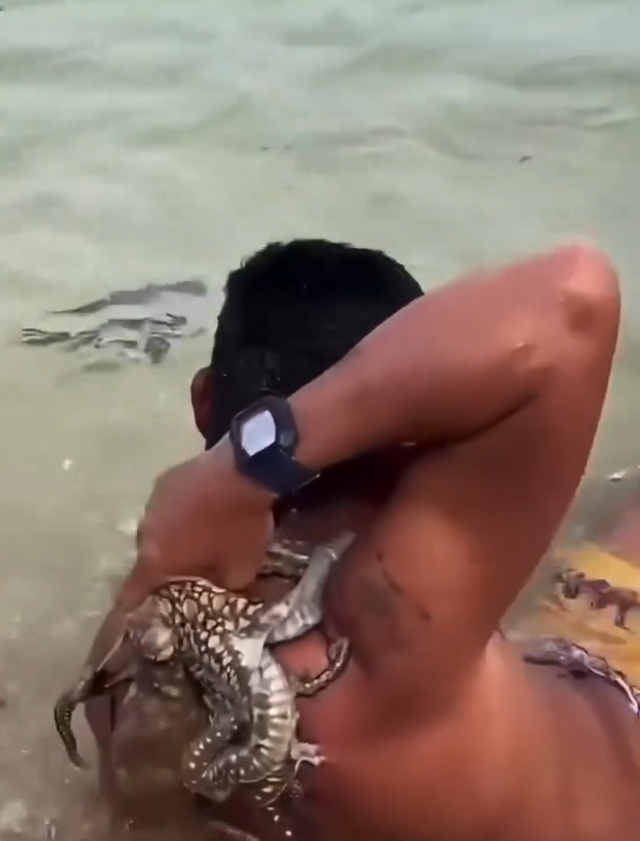
What began as an ordinary afternoon at a crowded beach quickly turned into a scene that few people nearby expected to witness.
A swimmer enjoying the water suddenly found himself in an unusual struggle after an octopus latched onto his back. With its tentacles stretched across his body like a living cape, the animal held on tightly as the startled man desperately tried to understand what was happening.
The swimmer twisted and reached behind himself, attempting to pull the creature away. But an octopus is remarkably well equipped for holding onto surfaces. Its arms are lined with powerful suckers capable of creating a surprisingly strong grip, making the animal much more difficult to remove than its soft appearance might suggest.
For people watching from the beach, the encounter was both fascinating and frightening.
Some onlookers shouted instructions toward the swimmer, while others stood frozen as the strange scene unfolded only a short distance from shore. Phones quickly appeared as people began recording what was happening. What might normally have been a quiet encounter between a human and a marine animal suddenly became the kind of dramatic moment capable of spreading rapidly across social media.
The sight itself was unsettling. The octopus appeared almost wrapped around the swimmer, its arms moving and adjusting as he struggled to free himself. For someone unfamiliar with octopus behavior, the scene could easily look like an attack.
Yet encounters with octopuses are often far less dangerous than they appear.
### Why Would an Octopus Hold Onto a Person?
Octopuses are intelligent and highly curious animals, but they are also wild creatures. When startled, threatened or placed in an unfamiliar situation, their behavior can be difficult for humans to interpret.
Their suckers are important tools for survival. An octopus uses them to explore its surroundings, grip rocks, manipulate objects and capture prey. If one attaches itself to a person, the sensation can therefore be surprisingly powerful.
The experience can become frightening very quickly, particularly when the person does not know whether the animal intends to bite or simply wants to hold on.
Most octopus species are not looking for confrontations with humans. They generally prefer hiding among rocks, reefs and underwater crevices rather than interacting with swimmers.
Like many wild animals, however, an octopus may react defensively if it feels trapped or threatened.
That distinction matters. A frightening encounter does not necessarily mean an animal is deliberately hunting or attacking a person.
### A Powerful Reminder About the Ocean
The incident also highlights something that can easily be forgotten at popular beaches.
The ocean may be a recreational destination for humans, but it remains a vast natural ecosystem filled with wild animals.
Just a few meters from swimmers, there may be fish, crabs, rays, jellyfish, octopuses and countless other creatures going about their lives. Most encounters pass unnoticed. Occasionally, however, humans and marine wildlife cross paths in ways neither side anticipated.
That is when curiosity can quickly become panic.
Trying to grab, chase or deliberately handle marine animals can increase the possibility of defensive behavior. Giving wildlife space is generally the safer approach for both people and the animals themselves.
Octopuses in particular deserve respect. They are known for remarkable problem-solving abilities, camouflage and flexibility. Their soft bodies allow them to squeeze through extraordinarily small openings, while their arms give them an impressive ability to investigate and manipulate their surroundings.
Those same characteristics that make octopuses fascinating can make an unexpected close encounter deeply unnerving.
### When Curiosity Turns Into Fear
Perhaps the most memorable part of the beach encounter was the contrast between the animal’s appearance and the swimmer’s reaction.
To an observer, an octopus spreading its tentacles across someone’s back can look almost surreal. To the person experiencing it, however, feeling multiple powerful suckers attached to the skin while surrounded by water can be terrifying.
Fear can also make an already unusual situation more difficult. A panicked swimmer may struggle aggressively, lose balance or exhaust himself while attempting to escape.
That is why encounters with wildlife should be treated calmly whenever possible, particularly in the water.
The dramatic scene ultimately serves as a reminder that humans are visitors when they enter the sea.
Beaches can feel familiar and controlled, especially when they are crowded with swimmers, umbrellas and families enjoying the sunshine. But only a short distance beneath the surface exists an entirely different world—one governed by instincts and behaviors that humans cannot always predict.
The octopus did not need to be a monster for the experience to be frightening.
Sometimes nature is unsettling simply because it refuses to behave according to human expectations.
And that may be the most important lesson from the extraordinary encounter: **the ocean is beautiful, fascinating and inviting—but it is never completely predictable.**