
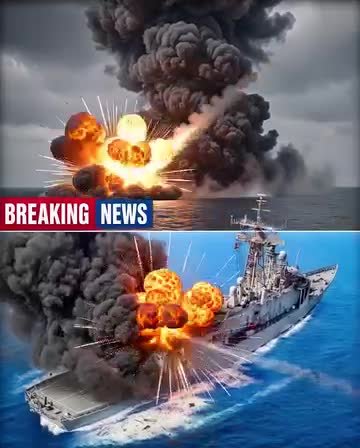
The publisher identifies this story as fiction. The reel does not show evidence that a U.S. carrier was sunk or that the events in the story took place.
The dramatic sequence follows a fictional confrontation between Iran and forces surrounding an American aircraft carrier. The story uses a countdown and language associated with breaking news to bring readers into the scenario. These choices make it possible to encounter the opening on social media without seeing the disclaimer that appears in the linked article. That disclaimer provides the context needed to understand why the video and text cannot be used as evidence of a current military event.
The image itself combines a ship, explosions and a public figure in a news-style layout. Each visual element can create an impression of immediacy even when the scene has no independently established location or date. Putting the elements together does not identify the source of the underlying images. The caption supplies its own account of what the scenes are meant to depict. That is consistent with how an illustrated fictional story is presented, where the purpose of the image is to represent a moment in the narrative.
Actual military reporting makes a different kind of claim. A dated statement can identify the organization making an allegation and the general location or time of an incident. Outside reporting may give other accounts based on its own sources. Readers can then compare those statements and distinguish what each source claims from what independent material establishes. The author of this particular story expressly says that it should not be read as a record of actual military actions. There is no basis for presenting the outcome shown in the reel as something that happened.
Within the story, the countdown gives the confrontation a quick pace. The headline tells the reader to expect a change after 32 minutes. That number is a device used to organize the scene. The article does not identify a real timeline for any named ship or an announcement from the people aboard. The difference is especially important when the content appears alongside genuine updates about events in the same region. The presence of real countries, real military terms and recognizable public figures does not turn an imagined sequence into documentation.
Readers who want to understand the original post can view it as a piece of dramatized storytelling. The reenacted or illustrative qualities are part of what makes the video attention-grabbing. Readers who want updates on a real incident would need to check dated communications about that incident. Those are different purposes, and this source makes its own purpose clear in the statement accompanying the story.
The phrase everything was gone belongs to the headline’s conclusion, whose meaning depends on the scenario the writer imagined. It does not describe a confirmed loss of an American carrier or establish that one was struck. The fictional disclaimer is an essential part of the published source and should travel with any description of the reel.
The video can still be discussed as an example of how a military scenario is packaged for social media. The subject of this post is that presentation and what the publisher says about it, with the sequence described as fiction throughout.