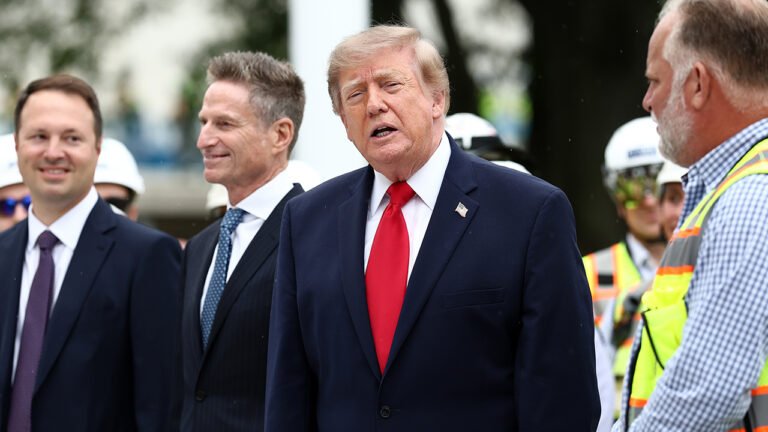
Donald Trump stood in front of the cameras at the White House, ready to speak.
There was just one problem.
No one could hear him.
As the president took part in a ribbon-cutting ceremony for the White House’s new helipad on Monday, viewers watching the event were left staring at footage of Trump speaking — while the sound of his voice was nowhere to be heard.
And the reason was directly connected to the escalating fight between Trump and the news media.
Just days earlier, Trump had banned CNN, MS NOW and Politico from the White House, accusing the outlets of publishing “fiction or lies” about his administration.
The three organizations have since sued the Trump administration, arguing that the move violates their First Amendment rights.
But the fallout quickly became much bigger.
ABC, CBS, Fox News, NBC and CNN make up the rotating television pool that provides live coverage of the president’s events and shares the footage with other news organizations. After CNN was prevented from carrying out its assigned pool duties, the other networks announced they would suspend pool coverage of presidential events rather than provide a replacement.
Then came the helipad ceremony.
Nobody could hear a word
The White House feed showed Trump speaking during the ribbon cutting, but without the normal pool equipment, there was no usable audio of his remarks.
Even Newsmax, a conservative network, pointed out the problem while airing the footage.
“There is no microphone because the pool cameras aren’t there,” a Newsmax anchor told viewers.
The anchor then added:
“So maybe this is one example of this backfiring just a little bit … the ramifications are right here — can’t hear what the president is saying.”
The awkward footage quickly spread online.
Political reporter Jamie Dupree summed up the problem bluntly:
“Here is what happens when you don’t have the White House TV Pool. You have video of Trump – but you can’t hear what the President is saying.”
The problem wasn’t just the missing microphone. The sound of a helicopter operating nearby made the footage even harder to understand.
One person reacting to the footage wrote:
“As the President of the United States this should feel embarrassing as hell.”
Another posted:
“Trump’s going to be embarrassed and p****d his plan backfired live in front of the world.”
Already heading to court
The awkward ceremony came as CNN, MS NOW and Politico took their fight with the White House to federal court. The three organizations say their journalists’ credentials were revoked because the administration objected to their reporting.
They are asking a judge to restore their access and arguing that the ban violates their constitutional rights.
Their joint statement said:
“This morning we notified the government that we are filing a lawsuit today to protect our First Amendment rights and defend the principle that the government does not decide what the press reports or publishes.”
They added:
“Without notice or process, the White House revoked our journalists’ credentials because it objected to our reporting.”
The White House has defended the decision.
Trump has repeatedly attacked what he calls “FAKE NEWS” and said the banned outlets should not have access to the White House.
“The White House is not instituting an assault on the Free Press, something which I cherish,” Trump wrote. “It is instituting an assault on the fake news, something that has grown like Cancer in our beloved United States of America.”
Impossible to miss
The dispute has now created a strange situation around presidential coverage.
Instead of the usual network cameras and crews providing a shared live feed, the White House is increasingly relying on its own coverage while major networks have stepped away from the presidential TV pool.
And during Monday’s ribbon cutting, the consequences were suddenly right there on screen.
Later that same day, Trump sat down with New York Mayor Zohran Mamdani for about an hour. The two later appeared together at a news conference, which was covered by local New York media.
Mamdani made it clear that he intended to keep journalists involved, saying: “I told the president that we’re going to have all of the members of the press here on the lawn, and that is something that I believe in.”
More outlets could face the same treatment
Trump, meanwhile, continued to criticize the media, arguing that news organizations often threaten to boycott him but ultimately “never boycott” him.
When Trump first announced his decision to bar CNN, Politico and MS NOW from the White House, he did not point to specific reports that had prompted the move. He later described it as the result of “cumulative stories over the last few years.”
He also suggested that more outlets could potentially face the same treatment.
When asked which organizations he had in mind, Trump replied: “Others to come in terms of fake news? Well, you know, the New York Times is fake news, the Washington Post is fake news.”
Presidents and news organizations have clashed over access before, and the White House has faced accusations of trying to keep unfriendly outlets at arm’s length.
One often-cited example came in 2009, when Barack Obama’s administration tried to exclude Fox News from participating in a press-pool interview with an administration official.
But the episode quickly became a test of how far the White House could go in deciding which news organizations received access. Other networks in the pool pushed back against the move, and Fox News was ultimately allowed to participate.
There was, however, an important difference between that dispute and the current fight involving Donald Trump.
The Obama administration’s move concerned one particular interview. It did not amount to a broader ban preventing Fox News from taking part in White House pool coverage altogether.
READ MORE